Long-term customer partnerships are often where the most meaningful innovation happens.
This has certainly been the case with SES (Società Elettrica Sopracenerina), whose journey with Spitch has evolved from a first FAQ voicebot into a multilingual collaborative agentic AI ecosystem supported by LLMs, RAG, and a Knowledge Agent.
What makes this story particularly interesting is not only the technological progression, but also the way the collaboration grew step by step – always grounded in the customer’s real needs, delivering measurable results at each stage, supported by close teamwork, and shaped by a shared ambition to improve the experience for users across linguistic regions.
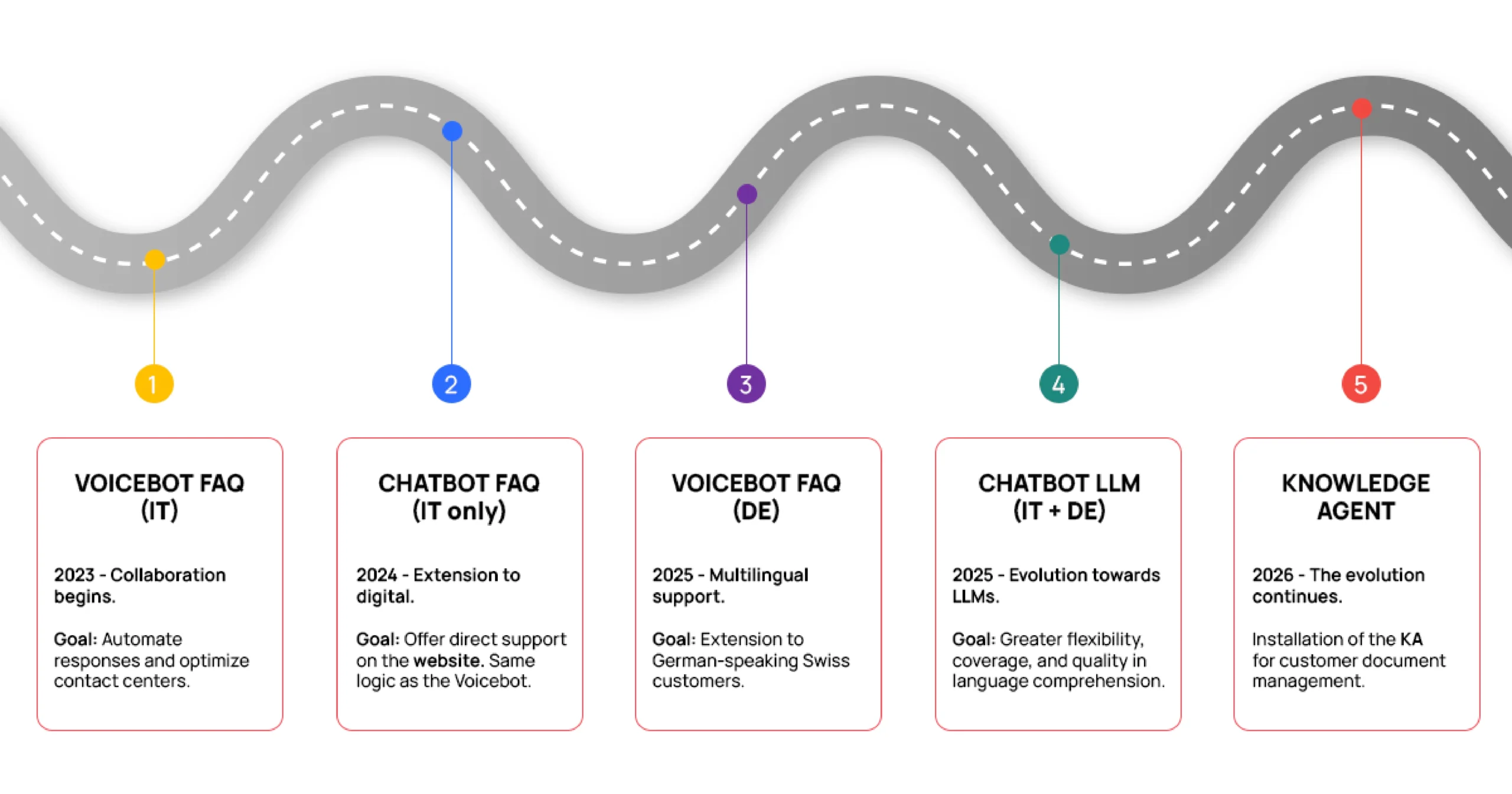
A first step into conversational automation
The journey began in 2023 with a clear and practical challenge: SES wanted to automate recurring FAQ requests on the voice channel in order to reduce manual handling and offer faster support to customers in the Swiss Italian market.
The first solution was an Italian voicebot based on NLU technology. It was built around a predefined set of intents and structured dialogue flows, making it well suited for predictable customer journeys. Users could call in and receive automated answers to common questions through a natural voice interaction, without needing to wait for a human agent.
For SES, this was more than just a new tool. It was the first step into conversational automation and a way to validate how voice-based AI could fit into existing support processes. The result was a foundation for future developments: repetitive requests were handled more efficiently, and the customer gained valuable experience with AI-driven interaction.
Extending the experience to chat
In 2024, the success of the voicebot opened the door to the next logical step: bringing the same logic into a digital chat channel.
SES wanted to extend the FAQ experience to customers who preferred text-based interaction, while keeping the handling consistent across channels. The answer was an Italian FAQ chatbot that mirrored the existing voicebot’s intent model and conversational structure.
This phase was important because it expanded automation beyond a single touchpoint. Instead of relying only on voice, SES could now offer users a consistent experience on the website as well. For customers, that meant more flexibility. For the business, it meant a broader and more coherent conversational strategy.
Going multilingual
The next milestone came in 2025 with the implementation of a German voicebot for the Swiss German market. This brought the project into a new phase: multilingual delivery.
The goal was to offer the same quality of automated support to German-speaking users while maintaining consistency with the Italian experience. The solution was aligned with the previous implementation but adapted to the German language, dialects, and to local expectations.
At this stage, collaboration became even more important. The project required close coordination between the Business Analysts managing the Italian and German streams, ensuring alignment across languages while respecting the specific needs of each market.
This was also a sign that the solution was no longer just a single use case. It had become part of a broader conversational ecosystem that could scale across markets.
From intent-based automation to generative AI
While the NLU-based chatbot worked well for predefined topics, its scope was naturally limited by the intent model. As SES’s needs grew, it became clear that users needed a more flexible and natural way to interact with the system.
That is where the next major innovation came in: the transition to a multilingual chatbot powered by LLM technology and Retrieval-Augmented Generation, or RAG.
The new chatbot supported both Italian and German and could handle a much broader range of questions. Instead of requiring users to phrase their request in a specific way, it enabled more open and intuitive conversations.
The key advantage of the RAG architecture was that responses were grounded in SES’s own documentation. This helped ensure that answers remained relevant, accurate, and aligned with trusted internal knowledge. In practice, it meant a better user experience, less friction, and greater flexibility for future growth.
This phase marked a major shift in the project – from rule-based, intent-driven interaction to generative AI supported by reliable content sources.
Strengthening knowledge governance with a Knowledge Agent
As the RAG-based chatbot became central to the experience, the quality and structure of the underlying documentation became even more important. Reliable responses depend on reliable knowledge.
To support that need, the next step was the implementation of a Knowledge Agent for document management. This allowed SES to independently manage, organize, and maintain the documents feeding the chatbot’s knowledge base.
This may sound like a technical detail, but in practice it was a significant milestone. Before this change, document updates had to go through the delivery process. With direct access to the Knowledge Agent, SES gained much more autonomy.
That shift improved agility, reduced dependency on the delivery team, and made it easier to keep the chatbot aligned with business updates. It also strengthened long-term scalability by creating a more sustainable model for knowledge maintenance.
A partnership built on trust and teamwork
Behind this innovation journey, there was also an important human story.
The collaboration between Spitch and SES was built through close customer engagement, steady communication, and a strong sense of partnership. From the first implementation onward, the relationship was based on understanding the customer’s business needs and continuously improving the solution together.
For Giorgia, who joined the project in 2024, the role was not only about requirements and delivery. It was about being close to the customer, analyzing performance, identifying opportunities for improvement, and helping translate business goals into practical solutions.
What stands out in this story is the team dynamic. The collaboration between Giorgia and Linda created a strong balance across markets and languages, with Linda leading the German stream. Their complementary strengths helped maintain continuity and alignment throughout the project.
Yury Lipkin, Lead Solution Architect for Utilities at Spitch, also played a key role by connecting the customer’s vision with technical feasibility. The stability of having consistent team members over time contributed to efficiency, trust, and a smoother delivery experience.
A story of evolution
The SES journey is a strong example of how conversational AI can grow over time when technology, people, and business needs evolve together:
- It started with a single Italian voicebot for FAQs.
- It expanded to chat.
- It went multilingual.
- It moved from NLU to LLM and RAG.
- And it now includes a Knowledge Agent that gives the customer greater control over its own content.
Each phase built on the one before it, creating not just a sequence of implementations, but a genuine innovation path.
For SES, that meant better customer support, broader channel coverage, multilingual consistency, and more autonomy over knowledge management. For Spitch, it was an opportunity to demonstrate how conversational AI can evolve in a way that is both technically advanced and operationally practical.
Most importantly, it shows what can happen when long-term collaboration is paired with a shared willingness to innovate.
Contact us to learn how Spitch collaborative agentic AI solutions can help your business today.
FAQ
The Collaborative Agentic AI Innovation Journey with SES (Società Elettrica Sopracenerina) and Spitch is a phased conversational AI transformation from a FAQ voicebot to a multilingual agentic AI ecosystem. It combines NLU, LLMs, RAG, and a Knowledge Agent.
The collaboration began in 2023 with a focus on automating recurring FAQ requests on the voice channel for the Swiss Italian market. The first deployment was an Italian voicebot built with Natural Language Understanding (NLU).
In 2024, SES extended the FAQ experience to a digital chat channel. In 2025, the solution became multilingual with a German voicebot for the Swiss German market.
The project moved from rule-based NLU to generative AI. SES implemented a multilingual chatbot powered by Large Language Models (LLMs) and Retrieval-Augmented Generation (RAG), grounded in SES documentation.
The Knowledge Agent gives SES control over knowledge governance. It lets the company manage, organize, and update the documents used by the chatbot, improving autonomy, agility, and content maintenance.
Key milestones include:
- 2023: Italian FAQ voicebot
- 2024: Digital chat channel
- 2025: German voicebot
- Shift from NLU to LLM + RAG
- Introduction of a Knowledge Agent
SES gained faster customer support, multichannel FAQ automation, multilingual consistency, and greater control over internal knowledge management.
The partnership demonstrates how conversational AI, agentic AI, and knowledge management can evolve in stages through close collaboration between a utility provider and an AI technology partner.
About the Authors