


Agentic AI in Contact Centers: A Practical Playbook Emerges from Spitch Survey
A new study from Spitch, “Spitch Expert Survey Agentic AI,” shows agentic AI moving rapidly from proof-of-concept to practical advantages in customer contact. Based on responses from 100 executives in Germany (70% with in-house contact centers, 30% outsourced), the research highlights strong momentum, clear business benefits, and a candid view of the implementation challenges leaders must manage.
What leaders mean by agentic AI
Respondents define agentic AI as a new generation of AI systems that can break down complex requests, work step by step toward a goal, and deliver accurate outcomes – think voice-based dialogue systems that handle multifaceted queries with natural, human-like conversation.
Momentum and market outlook
- 68% see agentic AI as a megatrend in contact centers.
- 77% believe it will massively change how AI is used in customer communication.
- 47% expect it to become the long-term standard; another 52% say that’s at least partially likely.
Why it matters: top benefits for CX, operations, and cost
- Elastic capacity when it counts: 64% rate flexible scalability during spikes as the most important benefit (another 30% say it’s important). Immediate scaling in unforeseen situations is crucial for 59% (for 32% – important).
- Always-on service without adding headcount: Half highly value 24/7 availability; 45% find it at least relevant.
- Faster answers, faster routing: 45% cite immediate responsiveness as a main advantage (another 55% see it as a key factor).
- Consistent quality and multilingual reach: 39% call consistent service quality very important (32% – important). 47% value multilingual service without translation overhead (37% – find it important).
- Data-driven optimization: Automated analysis is an important advantage for 41% and a very important one for 50%. 83% say richer data improves understanding of needs and drives better strategic decisions; 84% praise more efficient quality and process management.
- Personalization at scale: 55% rate individualized communication based on existing data as important; 36% – as very important.
- Cost-quality balance: 38% see significant cost savings with equal or better service as very important (33% important). 81% are convinced agentic AI reduces costs; 45% expect noticeable OPEX decreases. 60% firmly attribute savings to scalable AI capacity at consistently high quality (22% see it as one of the drivers).
Impact on people: relief, onboarding, and retention
Agentic AI is not just about handling volume – it’s reshaping work:
- Workload relief: Important for 50% of leaders; very important for 41%.
- Faster ramp-up: 82% believe AI-supported training accelerates onboarding; 74% say new employees integrate into workflows faster. Leaders also note onboarding is just one of many use cases (78%).
- Engagement and retention: 72% say agentic AI boosts agent motivation and loyalty by letting people focus on higher-value tasks.
Customer verdict: faster, more consistent, more precise
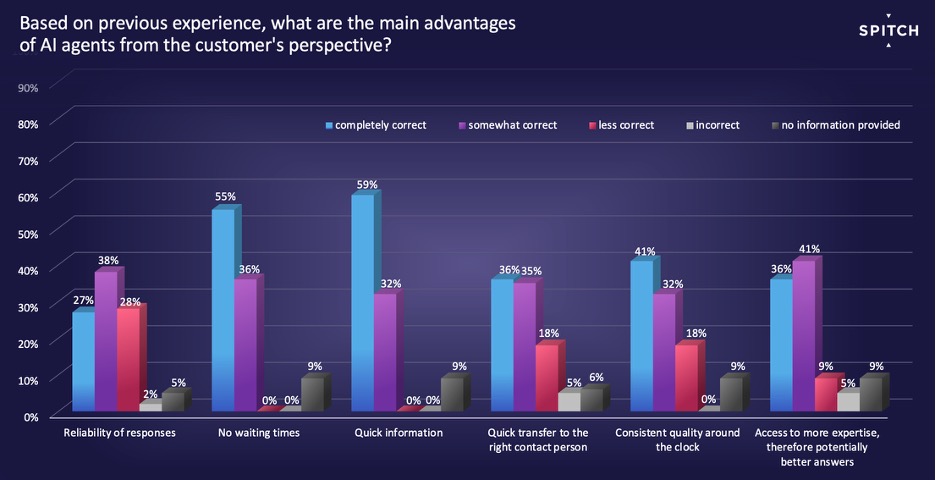
From the customer perspective, the benefits are clear:
- 91% highlight no waiting time and fast answers.
- 71% appreciate being quickly routed to the right human when needed.
- 73% are satisfied with consistent quality around the clock.
- 77% welcome access to more expertise during the interaction, leading to more precise and comprehensive answers.
- 65% praise the reliability of responses.
Business outcomes: differentiation and competitiveness
- 73% view agentic-AI-enabled service improvements as a key competitive differentiator.
- 63% link agentic AI to higher customer satisfaction and loyalty.
- 69% expect a sustained competitive boost, and 73% believe the market recognizes the innovation signal.
- 81% of respondents are certain that Agentic AI leads to cost reductions.
What to do now: a practical playbook
- Exploratory phase: Use speech analytics to map key intents, refine labeling, identify clear-cut automation scenarios, and get your data house in order.
- Start with high-impact, data-backed use cases: first-line voice self-service with precise intent recognition and call steering, multilingual FAQs, password resets, order status, and appointment changes.
- Design for escalation: Ensure seamless, context-rich handoff to human agents with transcripts and next-best actions.
- Build governance and trust: Establish privacy and security controls; define quality KPIs, monitoring, and guardrails for error handling.
- Invest in enablement: Use AI-driven training and workflows to speed onboarding and augment agents in real time.
- Measure outcomes: Track CSAT, FCR, AHT, containment, resolution accuracy, and cost-to-serve – and iterate fast.
Stephan Fehlmann, Vice President for Germany, Austria, and Switzerland at Spitch commented on the study results: “The overwhelming majority are convinced of the advantages and long-term viability of Collaborative Agentic AI that delivers autonomous handling of interactions with human-in-the-loop controls. As is to be expected with such a major technological leap, uncertainties arise regarding one or two aspects of its implementation. It is now up to the providers to prove that the use of Collaborative Agentic AI actually leads to the expected customer benefits.”
For full findings or to discuss implementation options, contact Spitch.


