


Beyond the Prompt: The Neural–Symbolic Future of CX
By Josef Novak, Chief Innovation Officer and Co-Founder at Spitch
I’ve spent the last week diving into three distinct perspectives on the future of AI: Andrej Karpathy’s “March of Nines”, the 2026 CIO Playbook for Governance, and a fascinating case study on „Autonomous Architects“ using multi-agent swarms to redesign legacy databases.
At first glance, database sharding and contact center IVR seem worlds apart. But in fact I think these trends converge at the nexus of a single, urgent challenge: How do we move AI from „impressive demos“ to „enterprise-grade, trustworthy solution „?
The 90% Trap (The „March of Nines“)
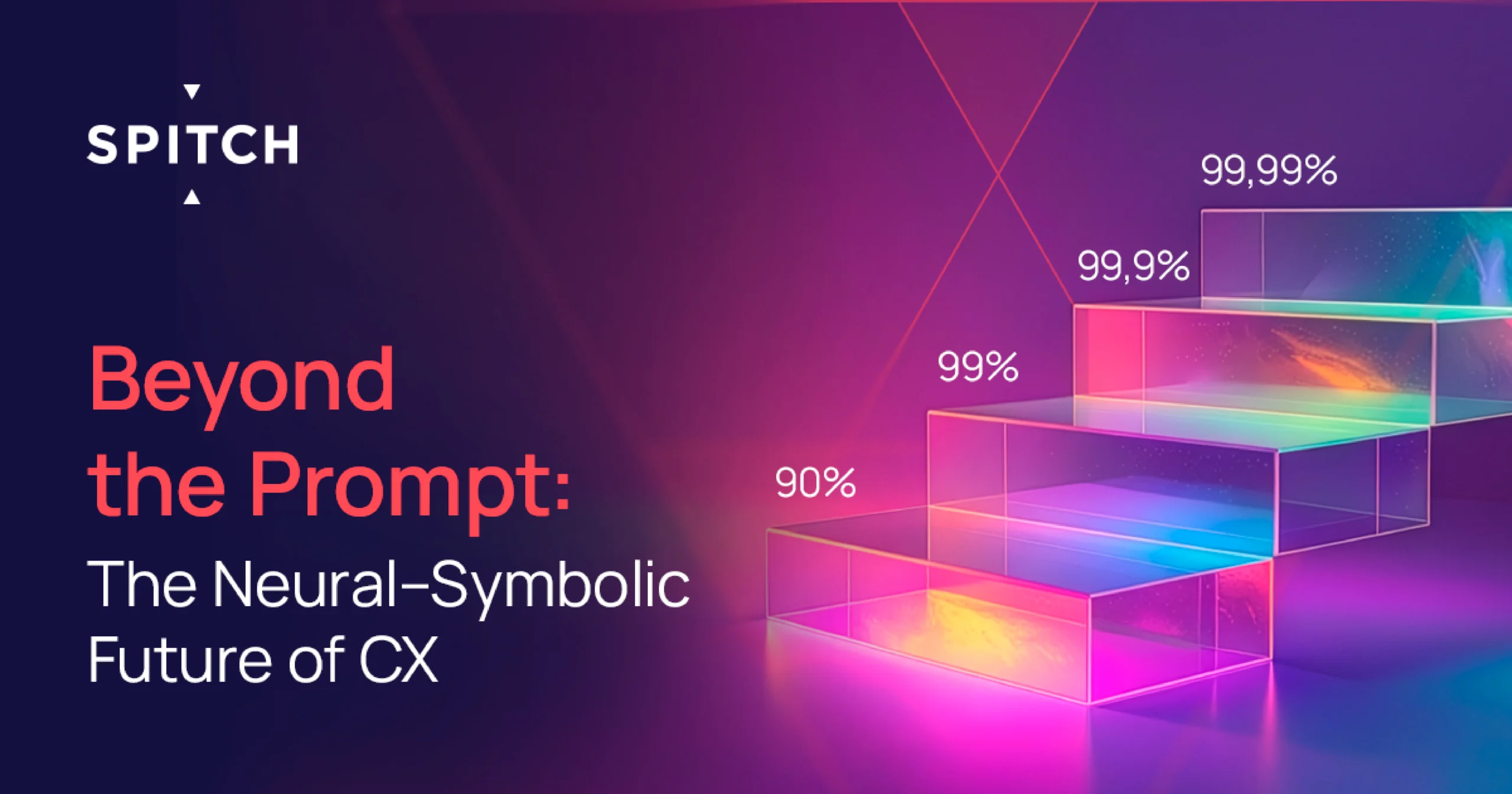
Karpathy notes in his article that getting a model to 90% accuracy is typically the easy part. Ok, not always but in Enterprise CX, 90% is a failure. If one out of every ten customers is misunderstood by your AI Agents, frontline trust collapses. But each subsequent nine – 99%, 99.9%, 99.99% gets dramatically more difficult to achieve.
To bridge the gap to those final „nines,“ where we finally achieve acceptable and then exceptional service, we have to stop treating LLMs as standalone magic boxes. We need to treat them as components within a larger, governed architecture.
The „Grounding Problem“ in Conversation
The „Autonomous Architect“ experiment highlighted a critical hurdle: the Grounding Problem. An AI agent can propose a mathematically perfect database schema that is functionally useless because it doesn’t understand the „messy“ political or operational nuances of the business.
In the contact center, grounding is even more essential. An S2S model might hear a customer say, „I’m done with this,“ and mathematically conclude the intent is „End Call.“ But a human agent – or a well-designed system – knows that in context, this might mean „Escalate to Retention.“
Without a framework to ground these „neural“ interpretations in „symbolic“ business logic, you aren’t building automation, your organization is just generating technical debt.
Our Approach: The Neural-Symbolic Hybrid
At Spitch.ai, we view and architect Collaborative AI as an assistive force, not a replacement. We address grounding by merging three elements:
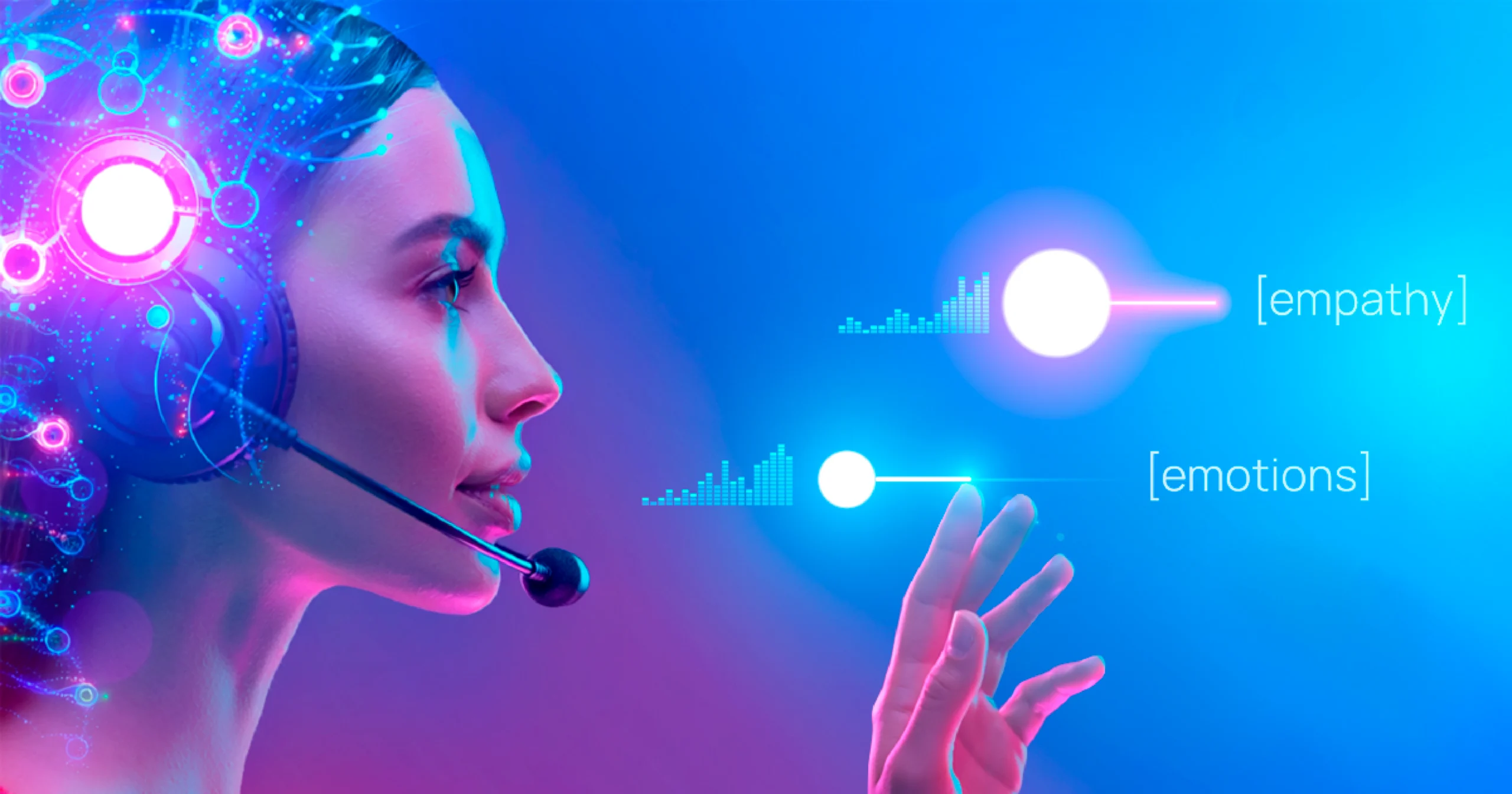
- The Neural (LLMs): We use SOTA Speech-to-Speech models as well as multimodal LLMs to handle nuance, empathy, and complexity of human language.
- The Symbolic (Guardrails): We bind that „creativity“ within deterministic state machines and „legacy“ logic like DTMF and transfer protocols.
- The Human Authority: All services exist to support humans – both the customers calling in to solve problems, and the human agents ultimately responsible for resolving them.
We don’t view DTMF, rigid transfer logic, or step-by-step directed call flows as „old tech.“ We view them as symbolic anchors. They are the platform-level guardrails that prevent an S2S model from „getting lost in the weeds“ during a live interaction – and the structure that allows LLMs to shine where they’re strongest.
Multi-Agent Debate at Design-Time
One of the most powerful recent shifts we are implementing is the move from simple Prompt-Completion to Distributed Reasoning.
- In Training: We use „Multi-Agent Swarms“ during the design phase. One agent acts as a frustrated customer, another as a compliance critic, and a third as an optimizer. They „debate“ the customer journey flow before a single customer ever hears it.
- In Production: We optimize the configuration to reduce latency and token usage, leaving a leaner customer journey template that operates within the „symbolic“ rails the AI Agents helped validate. Task-specific AI Agents still take on dedicated roles like order collection or escalation management, but tasks like producing a consistent initial greeting or retrieving CRM info can be handled as statically orchestrated steps that minimize token consumption.
The Rise of the Experience Curator
This shift changes the role of the customer journey designer. You no longer need to be a professional linguist or programmer; rather, you need to understand your contact center and the business and customers it serves. Like the „Autonomous Architects“ of data, our users are moving from „bricklayers“ of IVR scripts to curators of Customer Experience Journeys. The value here is that the CX stakeholders that know the operation best are more empowered than ever to guide the customer journey architectures that bring the greatest value.
The competitive advantage in 2026 won’t belong to the company with the „smartest“ model. It will belong to the company that can ship the most governed, grounded, and orchestrated autonomy. They will help businesses realize their CX visions more effectively than ever before, and ensure that customers always find what they are looking for.
At Spitch.ai, we aren’t just building agents that talk. We’re building the frameworks that make them listen. Contact us to learn more about our Collaborative Agentic AI Platform and solutions.
Verwandte Blogs
 Artikel
 Spitch Team
 11. Feb. 2026
 Artikel
Spitch Team
22. Jan. 2026
Artikel
Spitch Team
22. Jan. 2026
 Artikel
Spitch Team
19. Dez. 2025
Artikel
Spitch Team
19. Dez. 2025
 Artikel
Spitch Team
25. Nov. 2025
Artikel
Spitch Team
25. Nov. 2025
 Artikel
Spitch Team
21. Nov. 2025
Artikel
Spitch Team
21. Nov. 2025
 Artikel
Spitch Team
27. Okt. 2025
Artikel
Spitch Team
27. Okt. 2025


